
Days after the Supreme Court held as "illegal" the extension of ED Director Sanjay Kumar Mishra's tenure, the Centre on Wednesday moved the apex court seeking modification of its order to allow him to continue in office till October 15 in view of the ongoing FATF review.

On the revenue front, the finance ministry was expecting higher proceeds from non-tax revenue.
The World Bank's latest review of its purchasing power parity (PPP) baseline will reignite the poverty debate.

The CSO estimate is, however, a bit lower than 7.4 per cent growth projected by the Reserve Bank for the current fiscal.

Agriculture implements that are currently taxed up to 18 per cent may come under the 12 per cent or the 5 per cent bracket.

India's annual industrial output grew at a slower-than-expected pace of 3.6 percent in September.
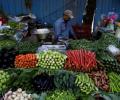
During the month, inflation in vegetables shot up to 35.99 per cent, as against 26.10 per cent in October. Likewise, the prices of cereals and eggs grew at a faster pace of 3.71 per cent.

Industrial production expanded a provisional 3.4 per cent year-on-year in June.

Shivakumar has got the all-important Major and Medium Irrigation and Bengaluru City Development, including the Bruhat Bengaluru Mahanagara Palike (BBMP), Bangalore Development Authority, Bangalore Water Supply and Sewerage Board, Bangalore Metropolitan Region Development Authority and the Bangalore Metro Rail Corporation Limited.

The Seventh Pay Commission had decided to choose the CPI-IW as the index for adjusting inflation for central government employees.

India's GDP had recorded 7.5 per cent growth in the April-June quarter of last fiscal.
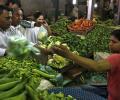
Declining vegetable prices brought down the retail inflation to a 15-month low of 4.59 per cent in December and within the comfort zone of the Reserve Bank, government data showed on Tuesday. It is for the first time during the current fiscal that the Consumer Price Index (CPI) based inflation print is below 6 per cent or in the RBI's target range of 2 to 6 per cent. The central bank factors in the CPI-based inflation while arriving at its monetary policy. The inflation in December 2020 came down from 6.93 per cent in November, mainly on account of 10.41 per cent decline in vegetable prices over the year-ago period.

Constituencies that are going to the polls in the first phase, slated for April 19, have just 19 days for campaigning. Contrast that with those going to polls in the 7th phase, notes N Sathiya Moorthy.

The BSE Sensex spurted 130.00 points to end at 35,980.93, while the broader NSE Nifty advanced 30.35 points to 10,802.15.

"The Right to Life as guaranteed by Article 21...gives the right to every human being to live a life of dignity with access to at-least bare necessities of life. To provide food security to impoverished persons is the bounden duty of all States and Governments," the top court observed while issuing a slew of directions on a plea of three activists.

'Everybody thought I was crazy to quit my job and jump into entrepreneurship.'
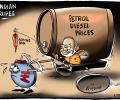
Retail inflation inches up to 3.77%; IIP growth dips to 3-month low

The Reserve Bank on Friday retained the GDP forecast for the current financial year at 9.5 per cent and flagged global semiconductor shortages, elevated commodity prices and potential global financial market volatility as downside risks to economic growth. In his address after the three-day meeting of the rate-setting panel, RBI Governor Shaktikanta Das said recovery in aggregate demand gathered pace in August-September, and it is reflected in high-frequency indicators, like railway freight traffic; port cargo; cement production; electricity demand; e-way bills; GST and toll collections. "The ebbing of infections, together with improving consumer confidence, has been supporting private consumption," he said, and added the pent-up demand and the festival season should give further fillip to urban demand in the second half of the financial year.
The manufacturing sector, which accounts for over 75 per cent of the index, declined by 2.4 per cent against a growth of 4.1 per cent in December 2014.
N R Bhanumurthy, professor of economics at the National Institute of Public Finance and Policy, and the author of the series, presented in a report to the National Statistical Commission, explains to Abhishek Waghmare various aspects of the methodology.

Rajan also said the outlook for agriculture is subdued, in view of both rabi and kharif prospects being hit by monsoon vagaries.

While India's GDP growth slowed to five-year low of 5.8% in Q4, China grew at 6.4%.

'When the average growth in the last three years was just 2.5%, how does that make us the fastest growing country?' 'They only tell you what has happened in the last 2 years; they are not taking into account what happened in FY21 on account of their mistakes.'
India's growth slowed in three months through December from a revised 7.4% expansion in the previous quarter, but it was much stronger than expected.
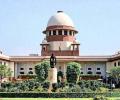
The observation was made by a bench headed by Justice UU Lalit which was hearing a plea seeking adequate infrastructure across the country for providing effective legal aid to women abused in matrimonial homes and creating shelter homes for them.

Only power generation grew faster in 2014 than in earlier years.

India's industrial production grew by 1 per cent in December, official data showed on Friday. According to the Index of Industrial Production (IIP) data, the manufacturing sector output grew by 1.6 per cent in December 2020.

India on track to be third largest consumer economy by 2025.
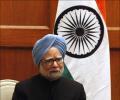
Experts say it will now be tough for the Modi government to catch up with the UPA's economic record owing to the shock induced by the currency demonetisation.

The Economic Survey was tabled in the Parliament on Friday.
GST rate cut for real-estate, income transfer scheme, farm loan waivers execution and recapitalisation of PSU banks have the potential to boost India's growth in a few months, says Neelkanth Mishra.
The Index of Industrial Production (IIP) grew by 1.4 per cent in November as most components like manufacturing, electricity, mining, primary goods, and consumer durables witnessed a slowdown, according to data released by the National Statistical Office (NSO) on Wednesday. This is on the base of a decline of 1.7 per cent in November 2020 and before the new Covid variant started impacting economic activity. IIP growth was lower than the 4 per cent expansion recorded in the previous month but was better than a 1.6 per cent contraction seen in November 2020. Separately, rising prices of kitchen staples pushed retail inflation, or rate of price increase, to 5.59 per cent in December 2021, bringing it close to the upper band of Reserve Bank's comfort zone.
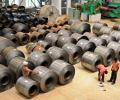
The mining sector grew by 4.3 per cent in June as against a dip of 4.6 per a year ago.
Data released earlier by CAG shows capital expenditure by the Centre had contracted 9.2 per cent in Q2

Believe it or not, the regulator is even stretching its arm to identify stressed borrowers and gauge the 'distance to default' as a measure of a particular bank's fragility, reveals Tamal Bandyopadhyay.

The combined share of customs and excise duties, service tax, and value-added tax in India's gross domestic product reached an all-time high of 10.5%.

Markets extended losses to end 1.5% down on Tuesday, amid weak global cues, after investors turned cautious ahead of key economic data and booked profits in rate sensitive shares while the further fall in the rupee continued to weigh on investor sent.

The slowdown is especially pronounced in rural areas, which have suffered two consecutive dry years.

The new numbers show India's economic growth rate averaged 6.7 per cent during the Congress-led United Progressive Alliance regime as compared to 7.3 per cent under the present government. Previous numbers had put the average growth rate during the 10-year UPA rule at 7.75 per cent.

Lakhs of students appear for it every year. How are you preparing for it?
